
Kerry Pride takes on the Mongol Derby
September 17, 2026
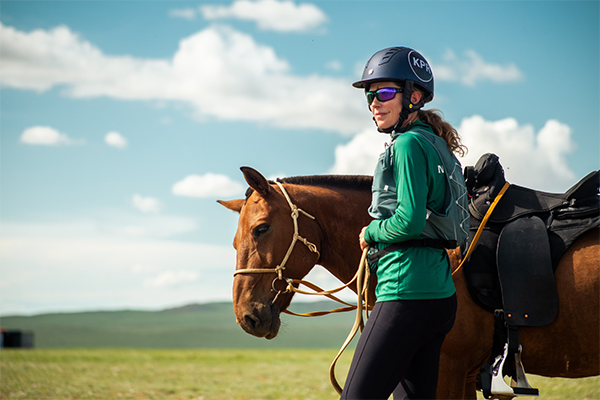
Dr. Kerry Pride in Mongolia.
– Tulgaa Skizz, courtesy of The Equestrianists
Riding horses 1,000 kilometers across the Mongolian Steppe was about more than a race for Dr. Kerry Pride. The Mongol Derby, widely known as the toughest and longest horse race in the world, offered a chance to test her resilience in one of the world’s most challenging environments. On Aug. 5, 2026, she mounted a semi-wild horse and set off on an adventure of a lifetime.
Dr. Pride grew up in Twin Bridges, Montana, in a family where horses and livestock were a way of life. Her family ranched and outfitted in the greater Yellowstone area, giving her the opportunity to spend much of her childhood on horseback, riding through the backcountry with a string of mules.
“I lived, ate, and breathed horses ever since I was a little kid,” said Dr. Pride, who graduated from LSU Vet Med in 2002.
That lifelong connection with horses eventually led her thousands of miles from Montana to Mongolia.
Dr. Pride first visited Mongolia in 2018 and quickly fell in love with the country. The vast, open landscape reminded her of what Montana may have looked like in the 1800s — open prairie without fences and filled with wildlife.
The Mongol Derby itself presented a challenge unlike anything she had ever experienced.
“It is grueling and challenging,” Dr. Pride said.
The trip on horseback covers a distance equivalent to traveling from Chicago to Washington, D.C., and can last up to 10 days. Riders travel by relay, switching between semi-wild horses they draw at random every 35 kilometers at horse stations, known as urtuu, that are operated by nomadic herding families.
The horses are owned by the herding families, who provide them for the race. Before the competition, veterinarians evaluate the horses to make sure they are fit to participate. Riders can then draw horses at random throughout the race, creating a new challenge every 35 kilometers.
That uncertainty was part of the mental challenge.
“It’s a mental game,” she said regarding the uncertainty of drawing an unfamiliar horse she would ride for miles.
Riders never know what they will encounter when a horse is brought to them. A horse could be easy to handle or difficult to bridle, saddle or mount. Some horses may even buck or spook. Riders are allowed to redraw if a horse proves too difficult, but Dr. Pride never did.
Preparing for the Derby required more than simply spending time in the saddle. Dr. Pride knew she needed to be physically fit and strong enough to maintain her balance while riding unfamiliar horses for hours at a time. She worked out six days a week doing Power 90 Extreme, which is a program that spans over 90 days and includes different types of workout routines that target all the major muscle groups.
Race officials allow riders to carry a kit weighing no more than 5 kilograms, which is weighed at the starting line. Dr. Pride packed a sleeping bag, sleeping pad, headlamp, ibuprofen, water purification supplies, contact lenses, extra batteries, a coat, sunscreen and lip balm, along with a few other necessities.
Even with the strict weight limit, riders still had to be prepared for the unpredictable conditions of the Mongolian Steppe.
Riding hours ran from 7 a.m. to 7 p.m. Each day, riders had to decide how far they could travel before the riding window closed. Some competitors stayed at horse stations, while others camped wherever they were when riding hours ended or found a nomadic family willing to put the rider and their horse up for the night. A race veterinarian checked each horse and rider that did not stay in the horse station to ensure they had water and feed for the horses.
The race also had strict rules designed to protect both horses and riders. Veterinarians examined each horse before a rider took it and again when the horse was handed in, checking heart rate, soundness, and other factors. Riders could receive penalties for pushing a horse too hard or violating animal welfare rules.
While the Derby is an individual competition, Dr. Pride did not plan to take it on entirely alone. She arrived in Mongolia with her longtime friend, Buckshot Nelson. Nelson was one of the few people in Pride’s circle who was willing to take on the challenge with her.
“He’s the only one that was crazy enough to try it,” Dr. Pride said.
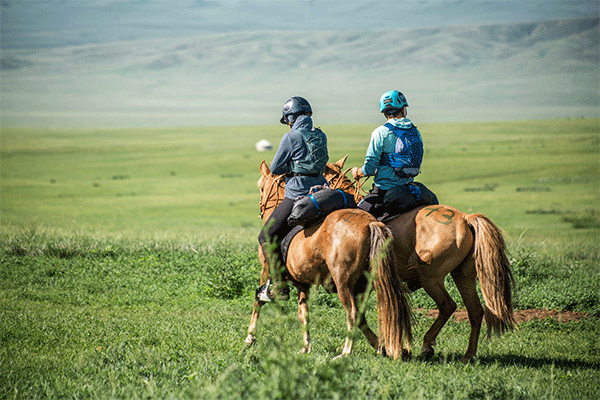
– Tulgaa Skizz, courtesy of The Equestrianists
The two planned to ride together throughout the race. After arriving in Mongolia, they connected with another Montana rider, Katrina Leyh. The three quickly formed a close friendship and became known as the “Montana Trio.” Their plans changed on the second day when Leyh’s horse spooked and bucked her off. She suffered injuries and had to leave the competition.
Dr. Pride and Nelson continued. On the third day, they realized they would not make it to a horse station before riding hours ended. As they searched for a place to spend the night, a Mongolian family welcomed them into their home. There was one problem: The family did not speak English, and they did not speak Mongolian. Communication became a combination of pointing, gestures, and, eventually, technology. The family’s pre-teen daughter downloaded Google Translate, giving the riders and family a way to communicate.
The family provided food and water and gave Dr. Pride and Nelson a place to sleep. They also kept watch over the horses during the night.
“It was a highlight of my Derby experience. The Mongolians are some of the most hospitable people,” she said.
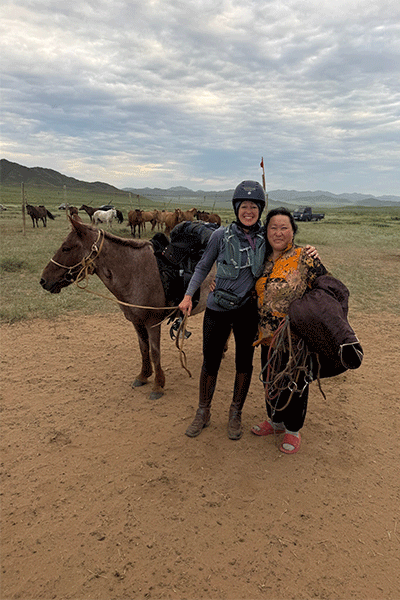
– Tulgaa Skizz, courtesy of The Equestrianists
Before leaving, Dr. Pride and Nelson gave the family gifts to thank them for opening their home to two strangers. Leaving them a sterling silver horse pin and some huckleberry chapstick for the kids. "We also left similar gifts at the horse stations we stayed overnight. The families work so hard for all of us,” Dr. Pride said.
The fourth day of the Derby was one of the hottest, creating difficult conditions for both horses and riders. The heat was so intense that horses could not travel at their normal pace.
Dr. Pride and Nelson walked their horses about 20 kilometers with their horses rather than putting strain on them by going at a faster pace. Eventually, they began running low on water and contacted the medical team, which brought them water and food.
By the end of the riding day, Drs. Pride and Nelson recognized that they were on the edge of heat exhaustion.
When they reached the horse station, they expected to stop, rehydrate, and continue the next day. Instead, they were told the station was closing, and they would have to continue. Dr. Pride considered all that would come next: drawing another unfamiliar horse, finding somewhere to sleep, and making sure both she and the horse had food, water, and shelter.
That was when she made the decision to stop competing in the race. It was a decision to listen to her body and recognize the risks of continuing.
The Mongol Derby offers the option to continue riding through the adventure class, which allows riders who are no longer competing to continue riding. Dr. Pride and Nelson decided to stay at start camp and do some exploring with other riders in the same boat. They went riding camels and explored the city of Karakorum. The decision allowed her to experience the best of both worlds: to explore Mongolia and to avoid the risks that came with continuing to ride as an adventurer in the competition.
Although she did not cross the finish line, the Derby gave her something more valuable, a renewed desire for adventure.
“There are so many wins you can have without ‘winning’ the race,” Dr. Pride said.
The Mongol experience has already led to new plans. Dr. Pride and several other Derby participants are planning to compete in the Tuk Tuk Tournament in Sri Lanka in 2028. She also hopes to ride in Portugal and Namibia with friends she met during the Derby.
“Definitely step outside your comfort zone, even if you don’t feel like you’re ready,” Dr. Pride said. “If you wait for everything to be perfect and to be ready, you won’t do anything.”